How it decides
How Mirox decides a bid.
Before any bid goes to Amazon, Mirox checks how likely a sale is, your stock, your limits and what the search term means. Here is how, in plain words.
See how it works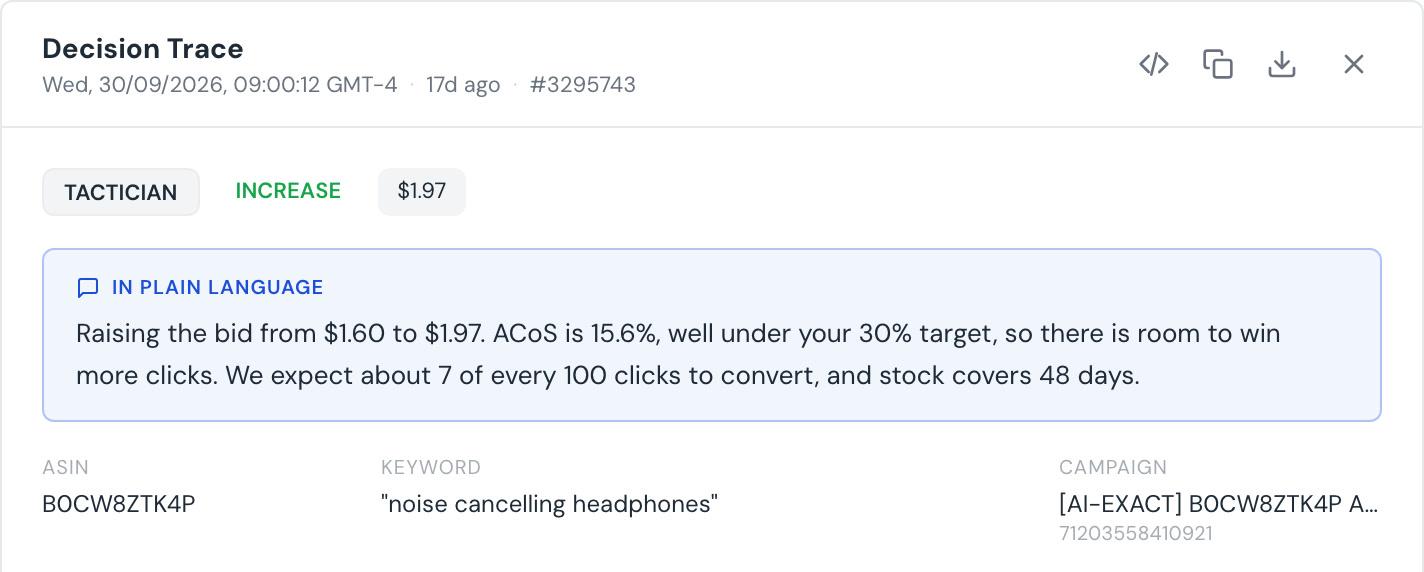
Demo account · sample data · US
The film
Five plain steps behind every bid.
How Mirox decides a bid, the plan it picks for each product, and how it sorts search terms by meaning.
41 seconds · with sound · English
Step by step
How one bid gets decided
Every hour, for every keyword, Mirox goes through the same five steps. If any step says no, the bid does not go out.
- Your dataSales, clicks and costs for each keyword.
- Will it sell?How likely a click is to turn into an order.
- Stock and Buy BoxEnough stock? Do you hold the Buy Box?
- Your limitsTarget ACoS, step size, kill switch.
- Bid sentTo Amazon, with the reason written down.
A plan per product
A new product and a bestseller need different bids
Mirox looks at where each product is and picks a plan for it. When things change, the plan changes too.
Done by the Strategist
Stock
Stock changes the bid
Most tools keep spending until a product sells out. Mirox checks your stock and your next shipment every time it bids.
Done by the Sentinel
You would sell out 5 days before the shipment lands.
Mirox slows the bid
$1.60$0.12
Fewer clicks while stock is short, so you don't sell out before the shipment arrives.
Search terms
Search terms, sorted by meaning
Shoppers rarely type your exact keyword. Mirox reads what a search term means, adds the good ones and blocks the ones you pay for but never sell to. It works in other languages too.
Done by the Semantic Analyst
What shoppers typed, and what Mirox does with it:
New keywords
New keywords get a fair test
A new keyword starts with small bids. Mirox keeps the ones that sell and stops paying for the ones that only cost money.
Done by the Explorer
- 1TryNew keywords get small test bids.
- 2WatchMirox counts the clicks and sales of each one.
- 3DecideIt keeps what sells and drops what only spends.
The proof
Read one decision
Every bid gets a screen like this one: what Mirox did and why, in plain words. This one is from our demo account.
Read a full decision, step by stepOpen to every seller
Watch it decide on your own account.
Free for 30 days on up to 50 of your parent ASINs, with the reason behind every bid.
Live on up to 50 parent ASINs you pick · your existing campaigns stay untouched